You gave your baby the best start — and somewhere along the way your breasts changed from full and firm to soft, empty and lower than they used to sit. If your chest feels “deflated” after breastfeeding and no amount of exercise brings it back, you’re not imagining it. This honest guide explains why breastfeeding changes the breasts, what genuinely helps, and the reliable way to restore fullness and lift when nothing else can.
The Two Issues
Why Exercise Fails
Makeover in Turkey
Full & Lifted
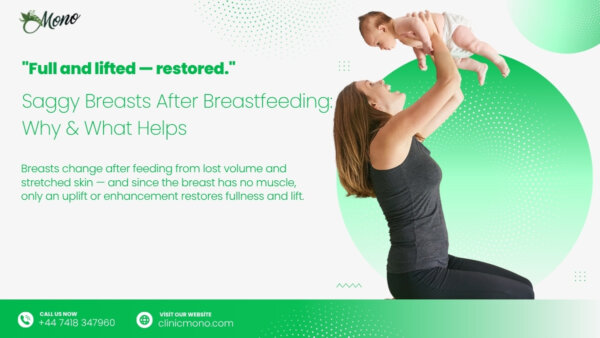
Breasts change after breastfeeding for two reasons: they lose the glandular volume that made them full, and the stretched skin and ligaments leave them sagging — and neither is reversed by exercise, because the breast has no muscle to tone. A breast uplift lifts and reshapes sagging breasts, a breast enhancement restores lost volume, and many mums combine one with a tummy tuck as a mommy makeover. The right fix depends on whether your main issue is volume loss, sagging, or both.
Why Breastfeeding Changes the Breasts
During pregnancy and breastfeeding, your breasts swell dramatically as the milk-producing glands enlarge — often growing a cup size or two. When you stop feeding, those glands shrink back down, but the skin and internal support that stretched to accommodate them don’t always shrink with them. The result is a breast that has less volume than before but a skin envelope that’s now too big — so it looks empty, soft and lower than it used to sit.
This is completely normal and happens to most women to some degree. It’s often described as “deflated,” and it’s why so many mums feel their breasts look emptier and more sagging after feeding than they ever did before children — even if they return to exactly the same weight.
Two Separate Problems: Volume and Lift
The key to understanding the fix is that “saggy breasts after breastfeeding” is really two different problems, and they need different solutions.
Lost Volume (Deflation)
The breast simply has less tissue than before, so it looks emptier and flatter, especially at the top. This is a volume problem.
Sagging (Loss of Lift)
The stretched skin and internal ligaments let the breast drop lower, with the nipple pointing down. This is a lift (position) problem.
Some women have mostly one, some have both. Which you have decides whether you need volume restored (an enhancement), the breast lifted (an uplift), or a combination — which is exactly what a consultation works out.
It’s Pregnancy, Not Just the Feeding
An important and reassuring point: research suggests it’s largely pregnancy itself — the swelling and stretching of the breasts during pregnancy — that drives these changes, more than the act of breastfeeding. In other words, choosing not to breastfeed doesn’t reliably protect the breasts, because much of the stretching happened before your baby was even born.
This matters because so many mums blame breastfeeding and feel they “caused” the change. You didn’t. The changes are a normal consequence of pregnancy, and they’d likely have happened either way — which, again, lifts the guilt many women carry about it.
Why Exercise Can’t Bring Your Breasts Back
This is the crucial, freeing fact: the breast itself contains no muscle. It’s made of glandular tissue, fat, skin and supporting ligaments. Underneath it sits the pectoral (chest) muscle — and while you can absolutely build that muscle with exercise, doing so doesn’t refill or lift the breast sitting on top of it.
So chest presses and push-ups can give a firmer platform and slightly improve posture, but they can’t restore lost breast volume or tighten stretched skin. Any “exercise to lift your breasts” advice is, unfortunately, wishful thinking for genuine post-feeding change — there’s simply no muscle in the breast to tone.
Creams, Pills and Other Myths
Save your money on these — none can restore a breast that’s lost volume or sagged:
- “Firming” creams and serums: may briefly tighten the skin’s surface feel, but can’t rebuild volume or lift the breast.
- Breast-enhancement pills and herbs: no supplement reliably or safely enlarges or lifts the breast.
- Cold water, massage and “exercises”: pleasant, but they don’t change the underlying tissue or skin.
- Taping and “lifting” bras: hold the breast up while worn, but change nothing once removed.
A supportive, well-fitted bra genuinely helps day to day and is worth investing in — but it’s a support, not a fix. Restoring the breast itself needs surgery.
How Much Sagging Do You Have?
Surgeons grade breast sagging (ptosis) by where the nipple sits relative to the crease beneath the breast:
Mild — Mostly Deflation
The breast looks empty at the top but hasn’t dropped much. Often restored with volume alone (an enhancement).
Moderate — Sagging + Some Deflation
The nipple sits at or below the crease. Usually needs an uplift, sometimes with an implant for lost volume.
Significant — Marked Sagging
The nipple points downward well below the crease. Needs a full uplift, often combined with an implant.
The Real Solutions
There are two core procedures, used alone or together depending on your grade:
Breast Uplift (Mastopexy)
A breast uplift removes excess stretched skin, reshapes the breast tissue and lifts the nipple to a higher, natural position — restoring a perkier, lifted shape without necessarily changing the size. It’s the answer when your main issue is sagging.
Breast Enhancement (Augmentation)
A breast enhancement uses an implant to restore the volume lost after feeding, refilling the emptiness — especially the “deflated” upper part. It’s the answer when your main issue is lost fullness rather than sagging.
Uplift + Implant Combined
Many mums have both deflation and sagging, so the two are often combined: an uplift to lift and reshape, plus an implant to restore volume. This delivers a fuller and lifted result in one operation — the most complete solution for post-feeding change.
Uplift vs Enhancement: Which Do You Need?
Combining It Into a Mommy Makeover
Because breasts rarely change in isolation, many mums combine their breast surgery with a tummy tuck (and sometimes liposuction) as a mommy makeover. Doing it all in one operation means one anaesthetic, one recovery and one trip — a big practical benefit. If your only concern is your breasts, an uplift or enhancement alone is perfectly reasonable; your surgeon will advise honestly.
What It Costs in Turkey
Cost is the main reason mums travel for breast restoration. The same procedures cost a fraction of Western prices in Turkey — because hospital and overhead costs are lower, not the standard of care.
Clinic Mono’s price is all-inclusive for a full makeover; a breast uplift or enhancement alone is quoted individually and costs less. Western prices are typically for the surgery alone.
Full detail is on our breast uplift, breast enhancement and mommy makeover pages.
Why Mums Choose Clinic Mono in İzmir
Clinic Mono is a trusted choice for restoring breasts after feeding, and the feedback from international mums is consistently positive — especially about honest advice on uplift versus implant, and how natural (not “done”) the results look.
Honest Advice on What You Need
We tell you whether it’s volume, lift, or both — and won’t fit an implant if a simple uplift gives you the result you want.
Board-Certified Plastic Surgeons
Experienced surgeons performing breast uplifts and enhancements routinely, in a fully accredited hospital.
All-Inclusive, English-Speaking Care
Surgery, hospital, hotel, transfers and aftercare in one transparent price, with English support throughout.
After feeding two babies my breasts were completely empty at the top and sat much lower than before — no chest exercise did a thing, because there’s no muscle in the breast to work. Clinic Mono did an uplift with a small implant and restored exactly what I’d lost: full and lifted, but natural. I feel like myself again, and it cost a fraction of the UK price.
Are You a Candidate?
Breast Surgery May Suit You If…
- →Your breasts are deflated or sagging after feeding
- →Exercise and bras haven’t restored the shape
- →You’ve finished breastfeeding for around six months
- →You’re in good health and a non-smoker
Wait a While If You…
- →Are still breastfeeding or stopped very recently
- →May have more children
- →Haven’t reached a stable weight
- →Have a health condition to optimise first
Share clear photos and we’ll tell you honestly whether you’d get the result you want from an uplift, an implant, or the two combined. No pressure to have more than you need.
Glossary
Frequently Asked Questions
Restore Your Breasts After Feeding — Free Assessment
Send clear photos via WhatsApp and our surgical team will reply within 24 hours with an honest verdict on whether you need an uplift, an implant, or both — plus a transparent all-inclusive price. No obligation, no pushy follow-ups.