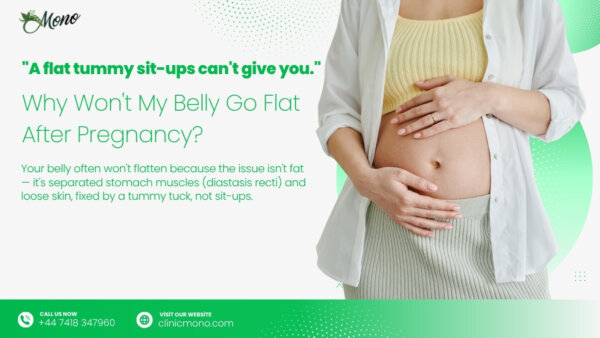
You’ve lost the baby weight, you plank and you eat well — but your lower belly still pooches out and won’t go flat. It’s one of the most frustrating and misunderstood parts of the post-baby body. This honest guide explains the real reason your tummy won’t flatten after pregnancy (hint: it’s often not fat), what genuinely helps, and the one thing that reliably fixes it when core work can’t.
The Real Cause
Diastasis Recti
Makeover in Turkey
Flat Again
Your belly often won’t go flat after pregnancy because the problem isn’t fat — it’s separated stomach muscles (diastasis recti) and loose, stretched skin, neither of which sit-ups or planks can fix. Pregnancy pushes the abdominal muscles apart and stretches the skin past its ability to recoil, leaving a rounded “pooch” no matter how lean or fit you are. Mild muscle separation can improve with physiotherapy, but a wide gap and loose skin are permanently corrected only by a tummy tuck — the core of a mommy makeover.
Why Your Belly Won’t Flatten — It’s Usually Not Fat
The most important thing to understand is that a post-baby belly that won’t flatten is often not a fat problem at all. Plenty of slim, fit mums who’ve lost every pound of baby weight still have a rounded lower tummy that pushes out — because the issue is structural, not stored fat.
Two changes are usually behind it: the abdominal muscles have been pushed apart during pregnancy (a condition called diastasis recti), and the skin has been stretched past its ability to spring back. Both leave the belly looking soft and rounded no matter how lean you get, and neither responds to the core exercises everyone recommends. That’s the honest, freeing truth: you can’t diet or plank away a problem that isn’t fat.
Diastasis Recti: the Muscle Gap Behind the “Pooch”
Your “six-pack” muscles run in two vertical bands down your abdomen, joined by a band of connective tissue in the middle. During pregnancy the growing bump stretches that tissue and pushes the two muscle bands apart — this separation is diastasis recti, and it’s extremely common, affecting most women to some degree after pregnancy.
When the muscles are separated, the front wall of your abdomen is weaker and can’t hold everything in flat, so your tummy bulges forward — especially the lower belly, and often more when you’re tired or after eating. This is the classic “mummy tummy” or “pooch.” Because it’s a gap in the muscle wall, tightening the muscles with exercise doesn’t close it; in fact certain exercises can make it look worse (more on that below).
Loose Skin: the Second Reason It Won’t Go Flat
Alongside the muscle gap, pregnancy stretches the skin of the abdomen dramatically. For some women it recoils well; for many it doesn’t fully bounce back, leaving loose, crêpey skin — often with stretch marks — that hangs or folds, particularly over a caesarean scar (the “C-section shelf”).
Loose skin is a separate issue from the muscle gap, and just as stubborn: once the skin’s elastic fibres are stretched past recovery, no cream, wrap, massage or workout tightens them. Many mums have both problems at once — a muscle gap pushing the tummy out and loose skin draping over it — which is exactly why core work alone never delivers a flat result.
How to Check Yourself for Muscle Separation
You can do a simple self-check at home:
- Lie on your back, knees bent, feet flat on the floor.
- Place your fingers just above your belly button, pointing down toward your toes.
- Gently lift your head and shoulders off the floor (like the start of a crunch).
- Feel for a gap between the two bands of muscle — if you can sink one, two or more fingers into a soft valley down the midline, you likely have some diastasis recti.
A small gap (one to two fingers) often improves with the right physiotherapy. A wider or persistent gap (two-plus fingers) that hasn’t closed after months of proper rehab usually needs surgical repair to truly flatten. A physio or surgeon can measure it accurately.
Why Sit-Ups and Crunches Can Make It Look Worse
Here’s the counter-intuitive part: the very exercises people reach for to “flatten the tummy” — sit-ups, crunches, certain planks — can actually make diastasis recti look worse. When you crunch with a muscle separation, the pressure pushes the abdominal contents forward through the gap, causing the midline to dome or bulge outward. Over time, aggressive crunching can even widen the gap rather than close it.
That’s why so many mums feel they’re “doing everything right” and getting nowhere, or even going backwards. The safe approach for a separated core is deep core and breathing work guided by a specialist, not traditional ab exercises — and even then, it can only do so much for a wide gap.
What Physiotherapy Can and Can’t Do
Postnatal physiotherapy is genuinely valuable and should be the first step:
- It can strengthen the deep core muscles, improve function and posture, and meaningfully narrow a mild separation.
- It can teach you safe movement and breathing that stop you making the gap worse.
- It can’t reliably close a wide separation — beyond a certain gap, the connective tissue simply doesn’t knit back together with exercise.
- It can’t remove loose, stretched skin at all — that’s a skin issue, not a muscle one.
So the honest sequence is: try dedicated postnatal physio first, give it several months, and see how much your gap narrows. If you’re left with a persistent gap or loose skin, you’ve reached the limit of what exercise can do — and that’s where a surgical repair comes in.
What Fixes What
How a Tummy Tuck Actually Flattens the Belly
A tummy tuck (abdominoplasty) is the operation designed for exactly this problem, because it fixes both causes at once:
Repairs the Separated Muscles
The surgeon stitches the two muscle bands back together down the midline, rebuilding a firm, flat abdominal wall — literally closing the gap that exercise can’t.
Removes the Loose Skin
The excess, stretched skin — often taking many stretch marks with it — is removed, and the remaining skin re-draped smooth and tight.
Restores a Flat, Firm Tummy
The result is the genuinely flat, firm stomach that no amount of core work could achieve — because it fixes the actual structural cause.
The scar sits low along the bikini line, usually below where a caesarean scar was, and fades over the first year. This muscle-and-skin combination is why a tummy tuck succeeds where every plank and diet failed.
Combining It Into a Mommy Makeover
Because pregnancy rarely affects only the tummy, many women combine their tummy tuck with other procedures as a mommy makeover — most commonly a breast uplift or breast enhancement for breasts that changed after feeding, and liposuction to refine the waist and flanks. Doing it all in one operation means one anaesthetic, one recovery and one trip, rather than fixing each area separately. If your only concern is the tummy, a tummy tuck alone is perfectly reasonable — your surgeon will advise honestly.
What It Costs in Turkey
Cost is the main reason mums travel to fix their tummy. The same procedures cost a fraction of Western prices in Turkey — because hospital and overhead costs are lower, not the standard of care.
Clinic Mono’s price is all-inclusive of surgery, hospital, hotel, transfers and aftercare; a tummy tuck alone is quoted individually and costs less. Western prices are typically for the surgery alone.
Full detail is on our mommy makeover in Turkey and tummy tuck in Turkey pages.
Why Mums Choose Clinic Mono in İzmir
Clinic Mono is a trusted choice for flattening the post-baby tummy, and the feedback from international mums is consistently positive — especially about honest advice on physio versus surgery, and how natural the flat, firm results look.
Honest About Physio vs Surgery
We’ll tell you if your gap might still improve with physio, or if it genuinely needs surgical repair — no rushing you into an operation.
Board-Certified Plastic Surgeons
Experienced surgeons performing tummy tucks and muscle repair routinely, in a fully accredited hospital.
All-Inclusive, English-Speaking Care
Surgery, hospital, hotel, transfers and aftercare in one transparent price, with English support throughout.
My lower belly stuck out for four years and I couldn’t understand it — I was slim and did core work religiously. Turns out my muscles were split three fingers wide. Clinic Mono repaired them and removed the loose skin, and my stomach is finally flat for the first time since my second baby. It wasn’t fat all along — it was the gap.
Are You a Candidate?
A Tummy Tuck May Suit You If…
- →Your belly won’t flatten despite being slim & fit
- →You have a persistent muscle gap or loose skin
- →Your family is complete and your weight is stable
- →You’re in good health and a non-smoker
Try Physio First / Wait If You…
- →Have only a mild gap you haven’t rehabbed yet
- →May have more children
- →Gave birth recently or are still breastfeeding
- →Haven’t reached a stable weight
Share clear photos (front and side) and tell us your finger-gap check result, and we’ll tell you honestly whether physio might still help or whether a repair is what you need. No pressure.
Glossary
Frequently Asked Questions
Belly Won’t Go Flat? Get a Free Assessment
Send clear photos via WhatsApp and our surgical team will reply within 24 hours with an honest verdict on whether it’s muscle separation, loose skin or fat — and what will actually fix it — plus a transparent all-inclusive price. No obligation, no pushy follow-ups.