Body Shape · Updated for 2026
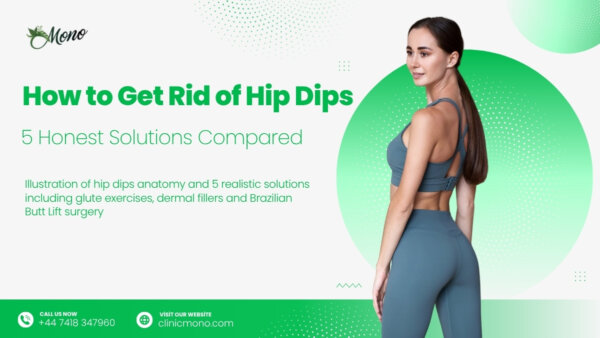
If you’ve been scrolling TikTok feeling self-conscious about the inward curves on the side of your hips, this honest guide is for you. We’ll explain what hip dips actually are, debunk the myths, and walk through every realistic option — from free exercises to permanent fixes — so you can decide what’s right for you.
Women Have Them
Main Cause
To Reduce Them
Truly Permanent
Quick Answer
Hip dips are inward indentations on the side of the hips caused by your bone structure — not by fat or lack of exercise. They are completely normal and affect most women. You can reduce their appearance through targeted glute exercises, smart clothing choices and dermal fillers, but only fat transfer surgery (Brazilian Butt Lift) provides a permanent, dramatic change to the silhouette.
What Are Hip Dips? (And Why You Might Have Them)
Hip dips are the inward curves on the outer side of the hips, just below the hip bone and above the thigh. You’ll also hear them called “violin hips,” “trochanteric depressions,” or simply “high hips.” They appear as a subtle indentation between your hip bone and the top of your thigh, creating a curvy “violin” silhouette.
The medical name — trochanteric depression — refers to the natural anatomical space where the greater trochanter (the bony bump at the top of your thigh bone) meets the iliac crest of your pelvis. The skin and soft tissue dip slightly inward at this junction in most people.
The term “hip dips” makes them sound like a flaw. Anatomically, they’re not — they’re simply the natural shape of your skeleton showing through your soft tissue. Some bodies show them more prominently; others barely at all. Neither is “better” or “worse” — just different anatomy.
Are Hip Dips Normal?
Yes — overwhelmingly so. Studies of body composition suggest that around 80% of women have some visible degree of hip dips, depending on their lighting, posture, and body fat percentage. Even fitness models, professional athletes and Olympic gymnasts have visible hip dips when you look at unedited photographs.
Hip dips became a “concern” largely because of social media — specifically the rise of TikTok and Instagram filters that smoothed body shapes into impossible hourglass silhouettes. When real women compared themselves to those filtered images, the natural inward curve of their own hips suddenly looked like a defect that needed fixing.
It isn’t. But if your hip dips bother you aesthetically — and only you can decide whether they do — there are realistic options. Just understand: you’re choosing to alter a normal anatomical feature, not correct a deformity.
What Actually Causes Hip Dips?
Hip dips are caused by the interaction of four factors, and three of them are 100% genetic:
Pelvic Bone Width & Shape
The distance between your hip bones (iliac crest) and your femur head (greater trochanter) determines how deep your hip dips appear. Wide-set hips = more visible dips. You’re born with this.
Greater Trochanter Prominence
The bony knob at the top of your thigh bone — some people’s stick out more, creating a more defined “shelf” above the dip. Pure genetics.
Where Your Body Stores Fat
Your body’s fat distribution pattern is largely genetic. Some women store fat in the hip dip area (filling it in naturally), others store it elsewhere — leaving the dips visible regardless of weight.
Glute Medius Muscle Development
The only factor you can directly change. The glute medius is the side-glute muscle that sits where the dip appears. Strengthening it can fill in part of the dip — but only part.
Being overweight, being too thin, eating poorly, not exercising enough, “weak” glutes, sitting too much, or anything else you’re doing “wrong.” They are not a punishment for lifestyle choices. The healthiest, fittest women in the world still have them.
The Truth About Exercise and Hip Dips
Walk into any fitness influencer’s content and you’ll be promised that “these 5 exercises will eliminate your hip dips in 30 days.” Here’s what they don’t tell you:
Exercise can reduce the appearance of hip dips by approximately 10–30%, depending on your starting muscle mass and how prominent your bone-driven dips are. That’s a real, meaningful improvement — but it’s not elimination. If your hip dips are deep due to wide pelvic structure, no amount of squats or side leg raises will close them completely.
This is because exercise can:
- Build muscle in the surrounding glute area (especially glute medius)
- Improve overall muscle tone, making the surrounding curves more defined
- Reduce body fat percentage (which can sometimes make dips more visible, paradoxically)
But exercise cannot:
- Change your pelvic bone structure
- Add fat tissue specifically to the dip area
- “Spot-build” muscle directly inside the indentation (there’s no muscle there to grow)
Now that we’ve set realistic expectations, here are the 5 solutions ranked from easiest/cheapest to most permanent — so you can choose where to invest your effort and money.
Solution 1: Targeted Exercises (The Free Option)
The cheapest starting point. Expect 10–30% improvement with consistent training over 3–6 months. Best for people with mild-to-moderate hip dips who want a natural approach. Below are the eight most effective exercises, in priority order.
Side Leg Raises (Banded)
Lying on your side, lift your top leg slowly to 45°. Add a resistance band above the knees. 3 sets of 15 each side. Targets glute medius directly.
Fire Hydrants
On hands and knees, lift one knee out to the side (90° angle), keeping the knee bent. 3 sets of 12 each side. Excellent for hip abductor activation.
Curtsy Lunges
Step one leg behind and across the other into a curtsy position, then return. 3 sets of 12 each side. Hits the glute medius from a different angle.
Glute Bridges (Weighted)
Lying on your back, lift your hips with a barbell or dumbbell on your pelvis. 3 sets of 12. Builds the overall posterior chain.
Bulgarian Split Squats
Rear foot elevated on a bench, drop into a lunge with the front leg. 3 sets of 10 each side. Heavy compound movement for glute development.
Cable Hip Abductions
Standing, ankle attached to a cable, kick leg out to the side. 3 sets of 15 each side. Targets glute medius with progressive overload.
Sumo Squats
Wide stance squat with toes turned out. 3 sets of 12. Engages the inner glutes and helps build width.
Side-Lying Clamshells
Lying on your side with knees bent, lift the top knee while keeping feet together. 3 sets of 20 each side. Pure glute medius isolation.
Pro tip: Progressive overload matters more than the specific exercises. Adding 1–2.5kg of weight every 2 weeks is what actually grows muscle. Eating sufficient protein (1.6–2.2g per kg body weight) is non-negotiable. Without these, you’ll plateau quickly.
Realistic timeline: Visible muscle change at 8–12 weeks. Maximum improvement at 6–9 months. Maintained only if you keep training — stop and the dips return.
Solution 2: Clothing & Styling Tricks (The Instant Option)
This won’t change your body at all — but it can change how your silhouette appears within seconds. Cost: nothing if you already own the items, or £20–£100 for new pieces. Best for special occasions when you want a quick fix.
✓ What to Wear
- ✓High-waisted jeans and bottoms
- ✓A-line skirts that flare from the hip
- ✓Belt-cinched dresses at the waist
- ✓Wrap dresses with waist tie
- ✓Peplum tops
- ✓Padded hip shapewear (instant fill)
- ✓Skater dresses
✕ What to Avoid
- ✕Low-rise jeans
- ✕Tight bodycon dresses (highlight dips)
- ✕Bottoms with side pockets at hip dip level
- ✕Horizontal stripes at hip level
- ✕Cropped tops that end at hip dip level
- ✕Shapewear that compresses the hips
- ✕Pencil skirts (depending on body shape)
Padded hip shapewear deserves special mention. Brands like Bombshell, Empetua and certain Shapermint products include silicone pads inserted into the hip dip region. They create an instant smooth, curved silhouette for that special outfit, party or wedding — and disappear when you take them off.
Solution 3: Strategic Glute Building (The Athletic Approach)
This is Solution 1 taken seriously. If you commit to a structured 6–9 month muscle-building programme — gym-based, progressive overload, calculated nutrition — you can achieve 20–40% improvement in hip dip appearance. This is the maximum exercise alone can deliver.
What This Actually Requires
- Caloric surplus: 200–400 calories above maintenance daily to grow muscle
- Protein: 1.6–2.2g per kg of body weight, every single day
- Training frequency: 3–4 dedicated lower body sessions per week
- Progressive overload: Adding weight or reps every session
- Sleep: 7–9 hours per night for recovery
- Patience: Visible glute development takes 6+ months minimum
This approach builds genuine, sustainable muscle that fills out the area around the hip dip. It won’t fill the dip itself (there’s no muscle there to grow), but it makes the surrounding curves more pronounced — reducing the visual contrast.
If your hip dips are caused predominantly by wide pelvic bone structure (the most common cause), no amount of glute training will close them completely. The dip’s depth is set by bone geometry — exercise can reduce contrast around it, but not eliminate it.
Solution 4: Dermal Fillers (The Temporary Cosmetic Option)
For people who want a more dramatic change without surgery, injectable dermal fillers offer a middle ground. A licensed practitioner injects hyaluronic acid or biostimulatory filler (like Sculptra) into the hip dip area to physically fill the indentation. Results are visible immediately and last 12–24 months.
Types of Hip Dip Fillers
The Honest Pros and Cons
Advantages
- ✓No surgery, no anaesthesia
- ✓Visible results immediately
- ✓Recovery in 1–3 days
- ✓Reversible (HA fillers)
- ✓Lower commitment than surgery
Drawbacks
- ✕Temporary — repeated every 1–2 years
- ✕Large volumes needed (expensive)
- ✕Risk of lumpiness or asymmetry
- ✕Rare but serious vascular complications
- ✕Total long-term cost exceeds surgery
The maths gets interesting over time. £1,000 every 18 months for a decade equals roughly £6,500 — more than a permanent surgical solution. Filler is excellent for “trying out” the look before committing to surgery, but not the most economical long-term answer.
Solution 5: Brazilian Butt Lift (BBL) — The Permanent Solution
If you’ve reached this section, you’ve likely concluded that exercises and fillers won’t deliver the silhouette change you want. The Brazilian Butt Lift (BBL) — more accurately called autologous fat transfer to the buttocks and hips — is currently the only procedure that permanently eliminates hip dips by physically filling them with your own tissue.
How a BBL Closes Hip Dips
The procedure has three core steps:
Liposuction (Fat Harvest)
Your surgeon liposuctions fat from areas with excess — typically abdomen, lower back, flanks, or inner thighs. You get a bonus contouring effect in these areas.
Fat Purification
The harvested fat is centrifuged or filtered to separate viable fat cells from blood, oil, and damaged tissue. Only living fat cells are kept for re-injection.
Fat Transfer to Hip Dips
The clean fat is injected in small, layered amounts into the hip dip area and surrounding buttock. Modern surgeons use precise, multi-layer microinjection to ensure cells get blood supply and survive long-term.
Because the filler is your own living fat tissue, the result is permanent. Surviving fat cells stay in place for life. The look and feel is completely natural — no rippling, no synthetic feel, no maintenance.
Why BBL Works When Other Solutions Don’t
- It actually fills the dip: Other solutions work around the dip. BBL fills it directly with viable tissue.
- It’s customisable: Surgeons can sculpt the exact silhouette you want — fuller on top, more on the side, etc.
- Two-in-one contouring: Liposuction donor sites get slimmer in the process.
- Permanent results: No ongoing filler costs, no required maintenance.
For a complete breakdown of the procedure including all techniques, recovery and surgeon qualifications, see our detailed Brazilian Butt Lift in Turkey page.
All 5 Solutions Compared Side-by-Side
5 Hip Dip Myths You Should Stop Believing
❌ Myth: “Hip dips mean you’re unhealthy”
Truth: Hip dips have zero correlation with health, fitness or body fat percentage. Olympic athletes have hip dips.
❌ Myth: “Squats can eliminate hip dips”
Truth: Squats build glute mass but cannot change pelvic bone structure. They reduce, not eliminate.
❌ Myth: “Losing weight makes them go away”
Truth: Losing weight often makes hip dips more visible, not less. They’re a bone-and-fat-distribution issue.
❌ Myth: “Only some women have them”
Truth: Around 80% of women have visible hip dips. They’re so common they’re statistically normal.
❌ Myth: “BBL surgery is dangerous”
Truth: Modern BBL using subcutaneous-only injection has a mortality rate similar to standard cosmetic surgery (~1 in 15,000) when done by trained surgeons.
❌ Myth: “Hip dip cream/oil works”
Truth: No topical product can change bone structure or add fat tissue. Save your money.
BBL in Turkey: Cost & Process
If you’ve decided BBL is the right option, the cost difference between countries is significant. Here’s how Turkey compares to private surgery in the UK, EU and US.
The cost difference isn’t about lower quality. Turkish surgeons train internationally, use the same equipment (Vaser, Body-Jet, Microaire), and operate in hospitals accredited by the Turkish Ministry of Health and international bodies. The savings come from lower operating costs in Turkey — lab fees, hospital fees, and overheads are 60–80% below UK levels.
Patient interest is huge — UK women alone account for over 30,000 BBL trips to Turkey annually. For a complete breakdown of the BBL procedure, surgeon credentials, recovery timeline, and all-inclusive packages, see our full Brazilian Butt Lift in Turkey guide.
BBL Recovery: What to Expect
BBL recovery is more demanding than most cosmetic procedures because you cannot sit directly on your buttocks for several weeks. Here’s the realistic timeline.
Days 1–3: Bed Rest & Swelling
You’ll be on your stomach or side most of the time. Swelling peaks at 72 hours. Pain is managed with prescription medication.
Days 4–14: Light Walking
Short walks encouraged to prevent blood clots. Still no sitting on the buttocks. Compression garments worn 24/7.
Weeks 2–8: BBL Pillow Required
A specialised BBL pillow lets you sit by transferring weight to your thighs. Most patients return to desk work after week 2.
Months 2–6: Final Results Settle
Approximately 60–80% of transferred fat survives long-term. The remaining swelling subsides. Final silhouette is visible at 6 months.
Which Solution Is Right for You? Decision Guide
Use this honest framework to figure out which option best matches your situation, budget and goals.
Start with Exercises & Clothing If…
- →Your hip dips are mild
- →You want a £0 starting point
- →You’ll commit to consistent training
- →You’re under 35 and your body responds well to training
- →Permanent change isn’t critical
Consider Dermal Fillers If…
- →You want to “try” the new shape first
- →Surgery feels too intense right now
- →You have £900–£1,800 available
- →You’re comfortable with repeat sessions
- →You want fast, reversible results
Consider BBL Surgery If…
- →Your hip dips are deep or really bother you
- →You’ve tried exercise and want more
- →You want permanent change in one procedure
- →You have donor fat (BMI ≥ 22)
- →You can commit to 2–3 month recovery
Do Nothing If…
- →Your hip dips don’t actually bother you in real life
- →They only bother you in filtered Instagram photos
- →You’re under 18 (still developing)
- →You’re pregnant or planning pregnancy soon
- →Body image is currently fragile
There’s no shame in any choice — including doing nothing. Hip dips don’t need fixing. If they’re affecting how you feel about your body, you have options. But the goal should always be making peace with your body first, then choosing intervention from a place of confidence rather than self-criticism.
Hip Dips Glossary
Frequently Asked Questions
Considering BBL? Get a Free Personalised Plan
Send photos of the area via WhatsApp and our plastic surgeons will reply within 24 hours with realistic expectations, recommended technique and exact pricing. No obligation, no pushy follow-ups.