That little shelf of skin that hangs over your C-section scar — the “mum pouch” or “C-section shelf” — is one of the most common and most stubborn changes after a caesarean. This guide explains exactly why it forms, why it resists exercise so completely, and the realistic options for getting rid of it.
Behind the Shelf
Tethering Is Key
Surgical Fix in Turkey
With a Tummy Tuck
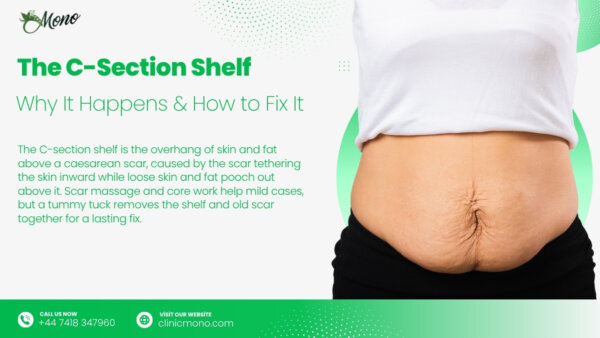
The C-section shelf is the overhang of skin and fat that forms above the caesarean scar, caused by the scar tethering the skin inward while loose skin and fat pooch out above it. Scar massage, core rehab and weight loss can soften a mild shelf, but they can’t release a tethered scar or remove loose skin. For a lasting fix, a tummy tuck removes the shelf and the old scar together and repairs the muscles stretched by pregnancy.
What Is the C-Section Shelf?
The C-section shelf is the small overhang of skin and fat that sits just above a caesarean scar, creating a distinct “ledge” or pouch on the lower abdomen. You’ll hear it called the “C-section pooch,” “mum pouch,” “mother’s apron” or simply the shelf. It’s extremely common — a natural consequence of how a caesarean heals combined with how pregnancy changes the abdomen.
What makes it so recognisable is its shape: a defined fold that hangs over the scar line, often with a visible crease where the scar pulls the skin inward. It can persist for years, completely unmoved by diet or exercise, which is exactly why so many mothers find it so frustrating. The reassuring part is that there’s a clear reason it behaves this way — and once you understand it, the right solution makes sense.
Why the C-Section Shelf Forms: 3 Causes
The shelf is rarely one thing. It’s usually a combination of three changes that pregnancy and surgery leave behind.
Scar Tethering
As the caesarean incision heals, scar tissue can bind the skin down to the deeper layers along the scar line. The skin above can’t lie flat, so it folds over the indentation — creating the shelf.
Loose, Stretched Skin
Pregnancy stretches the lower-abdominal skin enormously. If it loses elasticity, it stays loose and drapes over the scar regardless of weight.
Separated Muscles & Trapped Fat
Diastasis recti lets the belly bulge forward, while a small pocket of fat often settles just above the scar — both adding to the overhang.
The Scar-Tethering Problem — the Bit Most People Miss
Of the three causes, scar tethering is the one that explains why the shelf is so uniquely shaped and so resistant to everything you try. When a caesarean scar heals, the tissue underneath can adhere to the skin, fixing it in place at the scar line. This creates a permanent indentation — and the skin and fat just above it have nowhere to go but to fold forward over the top.
This is why losing weight rarely helps: even as the fat reduces, the tethered scar still holds that crease, and the shelf shape remains. It’s also why exercise can’t touch it — you can’t strengthen your way out of an adhesion in the skin. Gentle scar massage and mobilisation (ideally guided by a women’s-health physiotherapist) can soften mild tethering in the early months, but established scar adhesions with overhanging skin generally need surgical release to truly resolve.
Why Exercise Doesn’t Fix the C-Section Shelf
Mothers often throw months of core work at the shelf and feel like failures when it doesn’t budge. It’s not a failure — it’s that exercise simply can’t address what the shelf is made of.
- It can’t release a tethered scar. No movement undoes an adhesion binding skin to deeper tissue.
- It can’t remove loose skin. Stretched, inelastic skin drapes over the scar no matter how strong your core is.
- It can’t spot-reduce the fat above the scar. Fat comes off the whole body, not one ledge.
What exercise can do is rebuild the deep core and, if your muscles are separated, help a mild diastasis — which may flatten the area above the shelf a little. So core rehab is worthwhile, especially early on. But for an established shelf with a tethered scar and loose skin, it sets realistic expectations to know that training alone rarely makes it disappear.
What Genuinely Helps Without Surgery
If your shelf is mild and recent, several things are worth a real try before considering surgery:
- Scar massage and mobilisation — once fully healed and with your doctor’s okay, gentle massage can reduce mild tethering and improve how the scar sits.
- Silicone gel or sheets — can improve the appearance and pliability of the scar itself.
- Deep-core rehabilitation — rebuilding the transverse abdominis and addressing any muscle separation can flatten the surrounding area.
- Reaching a stable, healthy weight — reduces the fat component of the shelf, though it won’t remove loose skin or release the scar.
- High-waisted, supportive clothing — smooths the silhouette day to day while you decide.
These help mild cases and are always sensible first steps. If, after giving them a fair go, the shelf remains — particularly if the scar is clearly tethered and skin overhangs — surgery is the only route that genuinely removes it.
Will the C-Section Shelf Go Away on Its Own?
In the first several months postpartum, the lower belly is still recovering — swelling settles, the uterus shrinks, and a mild shelf may improve, especially with scar care and core work. So patience genuinely matters early on, and many mild shelves soften considerably within the first year.
But an established shelf — one still present a year or more after birth, with a tethered scar and loose overhanging skin — is unlikely to resolve on its own. At that point it’s a structural feature, not a temporary swelling, and waiting longer rarely changes it. Recognising when you’ve crossed from “still healing” to “this is permanent” saves a lot of frustration and helps you make a confident decision.
The Surgical Solution: How a Tummy Tuck Removes the Shelf
A tummy tuck (abdominoplasty) is uniquely suited to the C-section shelf, because it addresses all three causes at once — and, conveniently, the tummy tuck incision sits in almost exactly the same place as a caesarean scar.
Removes the Shelf and the Tethered Scar
The loose skin and the old, tethered caesarean scar are removed together, eliminating the fold and the crease that created it.
Repairs the Separated Muscles
Any diastasis recti from pregnancy is repaired, flattening the bulge above the scar that core work couldn’t reach.
Re-Drapes a Flat Lower Belly
The remaining skin is pulled smooth and the belly button repositioned, leaving one clean, low scar instead of the shelf.
Where a little fat sits alongside the shelf, liposuction is often added. For mothers who also want to address breast changes from pregnancy and feeding, the shelf repair can be part of a mommy makeover.
What Happens to the Old C-Section Scar?
This is the part many mothers are delighted to hear: in a tummy tuck, your existing caesarean scar is usually removed entirely. Because the tummy tuck incision is made low across the same region, the surgeon excises the skin containing the old scar along with the shelf, and closes with a single new incision placed low and flat to sit below underwear and swimwear.
So rather than adding a scar, a tummy tuck typically replaces a puckered, tethered caesarean scar with one clean, well-placed line — and removes the overhang that the old scar created. For many women, the scar improvement alone is a meaningful bonus on top of losing the shelf.
Cost in Turkey
The NHS does not fund tummy tucks for a C-section shelf, considering it cosmetic, and private UK prices are high — which is why many mothers look to Turkey, where the same surgery in accredited hospitals costs far less thanks to lower operating costs. Current packages are on the tummy tuck in Turkey page.
Why Mothers Choose Clinic Mono in İzmir
Clinic Mono is a popular choice for mothers addressing a C-section shelf, and the feedback is consistently warm — particularly about the sensitivity with which surgeons handle a part of the body many women feel self-conscious about.
Board-Certified Plastic Surgeons
Experienced surgeons who treat post-caesarean abdomens routinely, working in a fully accredited hospital.
Careful Scar Placement
Attention to placing the new scar low and flat, so it sits hidden beneath underwear and swimwear.
All-Inclusive, English-Speaking Care
One transparent price covering surgery, hotel, transfers and aftercare, with English-speaking support throughout and after you return home.
I had two C-sections and the shelf hanging over my scar never went, no matter how much I trained. Clinic Mono explained the scar was tethered — something I’d never been told. They removed the shelf and the old scar in one go, and my new scar is a neat little line I can’t even see in a bikini. I cried happy tears.
When Is It Safe to Have Surgery After a C-Section?
Timing matters for both safety and results.
- Wait at least 6–12 months after your caesarean so tissues have fully healed and any swelling has settled.
- Finish having children first, if you can. A future pregnancy can re-stretch the repair and undo the result, so most surgeons advise waiting until your family is complete.
- Finish breastfeeding and let your weight stabilise for several months for the most predictable outcome.
- Give conservative measures a fair trial — scar care and core rehab — so you know surgery is genuinely the right step.
A free photo assessment can tell you whether you’re a good candidate and when the timing is right, with no pressure to commit.
Caring for Your C-Section Scar from Day One
If you’ve recently had a caesarean, good scar care in the first year can reduce tethering and may lessen how pronounced a shelf becomes. It won’t remove an established shelf, but it gives the area its best chance — and it’s worth doing.
Let It Heal First, Then Massage
Once the wound is fully closed and your doctor confirms it’s safe (usually around six weeks), gentle scar massage and mobilisation can keep the tissue mobile and reduce adhesions binding the skin down. A women’s-health physiotherapist can show you the technique.
Use Silicone and Sun Protection
Silicone gel or sheets are among the best-evidenced ways to improve a scar’s appearance and pliability. Keeping the healing scar out of direct sun for the first months also prevents permanent darkening.
Rebuild the Deep Core Gradually
Restarting core work safely — starting with breathing and the transverse abdominis, not crunches — supports the abdominal wall and can flatten the area above the scar, especially if there’s mild muscle separation.
Know When It’s Beyond Self-Care
If, after a year of good scar care and core work, the shelf with its tethered scar and overhanging skin remains, it’s a structural feature that self-care can’t resolve — and surgery becomes the realistic route. Reaching that point isn’t a failure of your efforts; it’s simply the nature of established scarring and loose skin.
Glossary
Frequently Asked Questions
Tired of the Shelf Over Your Scar? Ask Us — Free
Send clear photos via WhatsApp and our plastic surgeons will reply within 24 hours with an honest, discreet assessment of your C-section shelf, what would fix it, and a transparent all-inclusive price. No obligation, no pressure.