Body Contouring · Updated for 2026
You did the hard part. You lost the weight — maybe through years of effort, maybe with the help of Ozempic or Wegovy — and instead of the body you pictured, you’re left with skin that hangs, folds and won’t snap back. This honest guide explains why that happens, what genuinely tightens loose skin, what doesn’t, and when surgery is the only thing that will.
The Real Issue
Of Skin Laxity
Tummy Tuck in Turkey
Surgical Result
Quick Answer
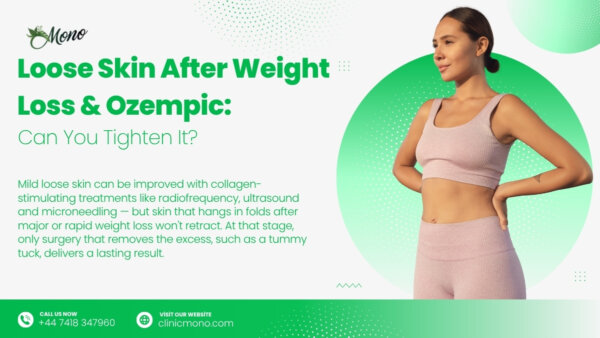
You can tighten mild loose skin without surgery using collagen-stimulating treatments like radiofrequency, ultrasound and microneedling — but only to a point. Once skin has lost its elasticity and hangs in folds (common after major or rapid weight loss, including with GLP-1 medications like Ozempic), no cream, device or workout will retract it. At that stage, surgery that physically removes the excess — such as a tummy tuck for the stomach — is the only treatment that delivers a lasting change.
What Loose Skin Actually Is — And Why Willpower Won’t Fix It
Your skin is not a passive wrapper. It’s a living organ with two proteins doing the heavy lifting: collagen, which gives it strength, and elastin, which lets it stretch and recoil like a rubber band. When you gain weight, your skin expands to cover the larger frame. Stay at that size long enough, and the elastin fibres are held in a stretched position for months or years. They fatigue. Some snap. The skin loses its memory of where it used to sit.
Why the Skin Doesn’t Snap Back
Then you lose the weight. The fat underneath disappears, but the skin — now oversized and short on elastin — has nowhere to go. It drapes. On the stomach it hangs in an apron or fold; on the arms it sways; on the thighs it crinkles. This is loose skin, and it is a structural problem, not a willpower problem.
Loose Skin Is Not Fat — and Why That Matters
This is the part most people get wrong, usually after months of frustration: loose skin is not fat, and it cannot be burned off. You can do a thousand crunches and run every morning, and the skin will not retract, because there is no fat left in it to lose. Exercise builds the muscle underneath, which can subtly improve the look, but it does nothing to the skin envelope itself. Understanding that distinction is the first step to choosing a solution that actually works instead of one that wastes another year.
Why Ozempic and Wegovy Made Loose Skin a Mainstream Problem
For decades, significant loose skin was mostly seen after bariatric surgery or pregnancy. That changed almost overnight with the rise of GLP-1 weight-loss medications — Ozempic, Wegovy, Mounjaro and Zepbound. These drugs are remarkably effective, and that’s exactly why they create so much loose skin.
The issue is speed and scale. Many people on GLP-1 medications lose 15–20% of their body weight in under a year. The skin simply cannot contract that fast. The phenomenon has become common enough to earn nicknames — “Ozempic face,” “Ozempic body” and “Ozempic belly” (sagging, loose skin around the waist after the fat is gone) — and it catches people off guard because they were focused on the number on the scale, not what would happen to the envelope around them.
There’s a second, quieter factor. Rapid weight loss often strips fat from everywhere, including the small fat pads that keep skin looking plump and supported. The result can be a body that is slimmer but looks deflated and older than expected. If you’ve lost substantial weight on a GLP-1 medication — or you’re considering one, or you’ve had gastric sleeve or gastric bypass surgery — loose skin is not a sign you did anything wrong. It’s the predictable physics of fast, large-volume weight loss.
Where Loose Skin Shows Up Most After Weight Loss
Loose skin tends to gather wherever the body stored the most fat and wherever skin was stretched the longest. Knowing the pattern helps you understand which procedure — if any — fits your situation, because each area is treated differently.
The Stomach
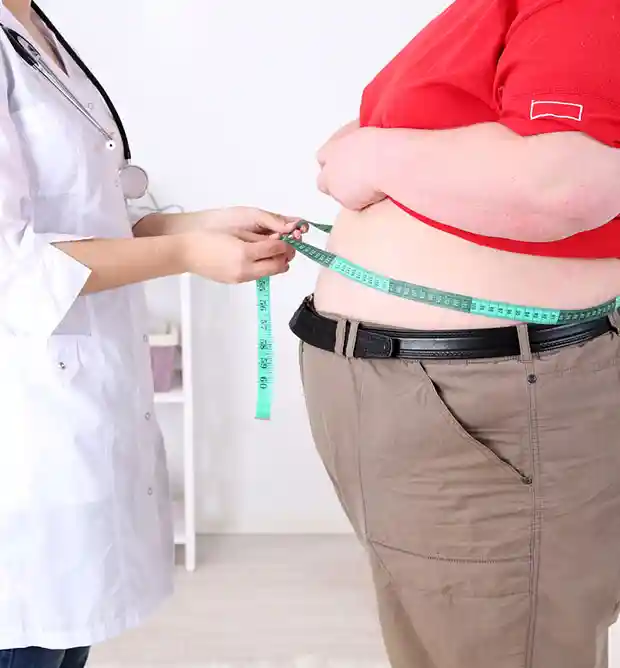
The abdomen is the number-one complaint, and the hardest area to treat without surgery. Skin here is often stretched by both weight and pregnancy, and the muscle wall underneath is frequently weakened too. When it hangs as an apron over the lower belly, a tummy tuck is the only reliable fix.
The Upper Arms
The “bat wing” — skin that sways under the upper arm — is extremely common after major weight loss. Triceps work tones the muscle but can’t shrink the skin envelope. The surgical answer is an arm lift (brachioplasty).
The Thighs and Knees
Inner-thigh skin loses elasticity quickly and can crinkle or chafe. Mild cases respond to skin-tightening devices; significant excess needs a thigh lift or skin-removal surgery.
The Breasts and Chest
Weight loss deflates breast volume and leaves the skin loose, causing sagging. A breast uplift, sometimes with an implant to restore volume, addresses this.
The Face and Neck
Rapid loss — especially on GLP-1 medications, hence “Ozempic face” — can leave the face looking gaunt and the jawline less defined. This is usually treated with fillers, energy devices or facial surgery rather than the body procedures discussed here.
Most people who lose a large amount of weight develop loose skin in two or three areas at once. This is why many patients plan their procedures in stages, or combine compatible ones in a single operation to save on recovery and travel. A full assessment maps out the most sensible order for you.
Will My Skin Bounce Back on Its Own?
Sometimes — partly — and it depends on a handful of factors you mostly can’t control. Skin has real but limited elastic recoil, and how much yours retracts comes down to the following:
- Your age. Younger skin holds more collagen and elastin and recoils far better. After roughly 40, natural collagen production drops sharply and recoil slows.
- How much weight you lost. Losing 10–15 lbs rarely leaves loose skin. Losing 50, 80 or 100+ lbs almost always does.
- How fast you lost it. Gradual loss gives skin months to adapt. Rapid loss (GLP-1 drugs, crash diets, bariatric surgery) outruns the skin’s ability to keep up.
- How long you carried the weight. Skin stretched for a decade has lost more elastin than skin stretched for a year.
- Genetics, sun exposure and smoking. All three affect baseline collagen quality. Smokers, in particular, have markedly poorer skin recoil.
Give it time. Skin can continue tightening for 6 to 12 months after your weight stabilises, so it’s worth waiting before judging the final result. Support that window with plenty of protein (the raw material for collagen), good hydration, strength training to fill the frame, and daily sun protection. But be realistic: these measures help mild laxity. They will not close a hanging fold of skin, and waiting longer than a year rarely changes the verdict.
The 3 Grades of Skin Laxity — Find Yours
The single most useful thing you can do is honestly identify how loose your skin actually is, because the right treatment is completely different at each grade.
Mild — Crepey or Slightly Lax
Skin looks a little soft, thin or crinkled but lies flat against the body. No real overhang. This is the grade where non-surgical collagen treatments genuinely help.
Moderate — Visible Sag, Small Fold
Skin hangs slightly and forms a soft fold when you bend or sit. Devices may give a modest improvement, but most people at this grade are happier with surgery.
Severe — Hanging Apron or Folds
Skin hangs in a clear apron (pannus), folds over itself, chafes or traps moisture. No non-surgical treatment can address this. Surgical removal is the only effective option.
Gently pinch the loose skin and lift it away from your body. If it springs straight back, you’re closer to mild. If it stays tented for a moment, or there’s a clear flap of skin with little or no fat inside, you’re in moderate-to-severe territory — and that’s a structural excess that needs to be removed, not tightened.
Is Loose Skin Just Cosmetic — or a Real Health Problem?
For many people, loose skin is purely an appearance and confidence issue, and that alone is a valid reason to address it. But once the excess is significant, it can cause genuine physical problems that go beyond how it looks.
Skin-Fold Rashes and Infections
Where skin hangs and folds, it traps heat and moisture. This creates the perfect environment for intertrigo — a red, sore, sometimes weeping rash in the crease — and recurrent fungal or bacterial infections. An overhanging stomach apron is a classic site.
Chafing, Odour and Hygiene
Folds rub against clothing and against each other, causing raw, broken skin. Keeping the area clean and dry becomes a daily chore, and persistent moisture can lead to a lingering odour that no amount of washing fully resolves.
Restricted Movement and Activity
A heavy apron of skin can interfere with exercise, intimacy and even comfortable clothing — sometimes undoing the active lifestyle the weight loss was meant to enable.
If you have recurrent rashes, infections or skin breakdown under a hanging fold, the issue has crossed from cosmetic into functional. Removing that excess skin isn’t an indulgence at that point — it resolves a real, ongoing medical problem. Mention these symptoms clearly during your assessment.
Non-Surgical Skin Tightening: What Genuinely Works (and What’s Hype)
For mild laxity, several treatments can produce a real, visible improvement. They all work the same way underneath: by injuring the deeper skin in a controlled manner so your body lays down fresh collagen over the following months. None of them remove skin — they shrink and thicken what’s there.
- Radiofrequency (RF): Heats the deep dermis to stimulate collagen. Devices like Morpheus8 combine RF with microneedling for a stronger effect. Good for mild crepey skin; gradual results over 3–6 months.
- Ultrasound (e.g. Ultherapy): Delivers focused energy to a precise depth, triggering collagen renewal. FDA-cleared for lifting; works best on mild laxity.
- Microneedling: Creates thousands of micro-channels that switch on the skin’s repair response. Improves texture and firmness, modestly.
- Lifestyle support: High protein, strength training, hydration, sun protection and a stable weight. These don’t tighten loose skin so much as give the skin its best possible chance and stop things getting worse.
The honest limitation, repeated by every reputable source: these treatments are for mild to moderate laxity. They cannot retract significant excess skin, and they certainly cannot lift a hanging stomach apron. Spending thousands on repeated device sessions chasing a result they were never designed to deliver is one of the most common and expensive mistakes people make after major weight loss.
Non-Surgical Treatments Compared
Diet, Supplements and Habits That Support Skin Elasticity
None of the following will retract a hanging fold of skin — be clear about that. But for mild laxity, and to give your skin its best possible chance during and after weight loss, these habits genuinely matter. They’re also what surgeons ask you to optimise before and after any skin-removal procedure, because healthier skin heals better.
Eat Enough Protein
Collagen is built from amino acids, so protein is the raw material your skin needs to stay firm and to repair itself. Aim for a consistent daily intake spread across meals — roughly 1.2–2.0g per kilogram of body weight, more if you’re very active. This is doubly important on GLP-1 medications, which suppress appetite and make it easy to under-eat protein and lose muscle along with fat.
Stay Hydrated
Well-hydrated skin looks and behaves more elastic. It won’t perform miracles, but chronic dehydration makes skin look more crepey and tired than it needs to.
Build and Keep Muscle
Strength training fills out the frame beneath the skin, which can noticeably improve how loose skin drapes. Losing weight while preserving muscle — rather than crash dieting — produces a far better final shape.
Protect Against the Sun and Don’t Smoke
UV damage and smoking both degrade collagen and elastin directly. Daily sun protection and not smoking are two of the most effective long-term things you can do for skin quality — and surgeons strongly advise stopping smoking well before any operation, as it impairs healing.
Lose Weight Gradually Where Possible
Slower weight loss gives skin time to adapt and retract. If you’re early in your journey, a steadier pace can mean less loose skin at the end — though with large amounts of weight, some excess is often unavoidable regardless of pace.
When Surgery Is the Only Honest Answer
If you’ve reached this section, the pinch test probably told you what you already suspected: you don’t have a skin quality problem you can treat, you have a skin quantity problem you have to remove. That’s not a failure of effort — it’s simply what a large skin envelope looks like once the fat beneath it is gone.
Body-contouring surgery after weight loss is one of the most satisfying areas of plastic surgery precisely because the result is so visible and so permanent. The procedure is matched to the area:
- Stomach: a tummy tuck (abdominoplasty) removes the excess skin and fat and tightens the muscle wall.
- Upper arms: an arm lift (brachioplasty) removes the hanging “bat wing” skin.
- Stubborn pockets of fat with good skin: VASER liposuction can refine the contour, often alongside skin-removal surgery.
- The whole post-pregnancy package: a mommy makeover combines abdominal and breast procedures in one operation.
- Loose skin across several areas at once: after very large weight loss, a body lift (a more extensive procedure that removes skin around the trunk in one stage) may be discussed — your surgeon will advise if your case calls for it.
Because the stomach is where loose skin bothers people most — and where it most often hangs, chafes and resists every other approach — the rest of this guide focuses there.
How a Tummy Tuck Actually Fixes the Stomach
A tummy tuck does three things no device or workout can:
Removes the Excess Skin and Fat
The surgeon removes the loose lower-abdominal skin entirely through a low incision hidden along the bikini line. The apron is gone — not shrunk, gone.
Tightens the Muscle Wall
Weight gain and pregnancy often separate the abdominal muscles (diastasis recti). The surgeon stitches them back together, flattening the core in a way no exercise can.
Re-Drapes a Flat, Smooth Contour
The remaining skin is pulled taut and re-draped, often removing lower-belly stretch marks in the process, and the belly button is repositioned naturally.
For people whose loose skin is mostly excess with little remaining fat, a standard or extended tummy tuck is ideal. For those who still carry fat as well as loose skin, surgeons frequently combine the tummy tuck with liposuction to sculpt the waistline at the same time. You can read the full breakdown of techniques, candidacy and results on our dedicated tummy tuck in Turkey page.
The Types of Tummy Tuck — and Which Fits Post-Weight-Loss Skin
“Tummy tuck” isn’t a single operation. The right version depends on how much excess skin you have and where it sits — which is exactly why an assessment matters before anyone quotes you a procedure.
Mini Tummy Tuck
Addresses only the small area of skin below the belly button. Suited to people with limited lower-belly looseness and no significant muscle separation. Smaller scar, quicker recovery — but rarely enough after major weight loss.
Full (Standard) Tummy Tuck
The most common version. Treats the skin both above and below the belly button, repairs the full length of the muscle wall, and repositions the navel. This is the workhorse procedure for most pregnancy and moderate-weight-loss patients.
Extended Tummy Tuck
Extends the incision around toward the flanks to remove skin that has gathered at the sides and hips as well as the front. A frequent choice after significant weight loss, where looseness wraps around the body.
Fleur-de-Lis Tummy Tuck
For very large amounts of excess skin — typically after massive weight loss or bariatric surgery — where the skin needs tightening horizontally and vertically. It adds a vertical incision up the midline, removing more skin at the cost of a longer scar. For the right patient it’s transformative.
Patients often arrive asking for a “mini” because it sounds gentler — but a mini tuck on a body that needs a full or extended version leaves loose skin behind and disappoints. The right approach is to let the surgeon match the technique to your skin during assessment, then explain the trade-offs so you can decide together.
Tummy Tuck in Turkey: What It Costs
The cost difference between countries is the main reason tens of thousands of patients travel for body-contouring surgery each year. Turkey offers the same techniques and equipment at a fraction of UK, EU and US prices — largely because hospital fees, staffing and overheads are far lower.
The savings aren’t a reflection of lower quality. Turkish plastic surgeons are among the most experienced in the world by sheer volume, train internationally, and operate in hospitals accredited by the Turkish Ministry of Health and international bodies. For a complete, current breakdown of inclusions and packages, see the tummy tuck in Turkey guide.
Why Patients Choose Clinic Mono in İzmir
Clinic Mono has become a trusted choice for post-weight-loss body contouring, and the feedback from international patients is consistently positive — particularly around how thoroughly each case is planned and how well people are looked after from arrival to flight home.
Board-Certified Plastic Surgeons
Your operation is performed by experienced, board-certified plastic surgeons in a fully accredited hospital — not a budget day-clinic.
Genuinely All-Inclusive Packages
Surgery, hospital stay, 4-star hotel, VIP airport transfers and aftercare are bundled into one transparent price — no surprise charges at the end.
English-Speaking Care, Start to Finish
A dedicated English-speaking coordinator guides you from your first photo assessment through recovery, with continued support after you fly home.
I lost 5 stone with Wegovy and was devastated by the loose skin — it undid all my confidence. Clinic Mono planned everything around me, the surgeon spent real time explaining what was realistic, and the result is honestly life-changing. The aftercare team checked in on me for months afterwards.
Tummy Tuck Recovery: What to Expect
Recovery from a tummy tuck is more involved than a non-surgical treatment, which is the trade-off for a permanent result. Here’s the realistic picture.
Rest & Compression
You’ll walk gently bent forward to protect the incision, wear a compression garment, and manage discomfort with prescribed medication. Drains, if used, are usually removed within this window.
Back to Light Routine
Most patients return to desk work and light daily activity. You’ll stand straighter each day. This is typically when international patients fly home.
Exercise Resumes
With surgeon clearance, you return to full exercise including core work. Swelling steadily settles.
Final Result Settles
Residual swelling resolves and the scar begins to fade. The flat, firm contour you’ll keep long-term becomes clear.
Which Option Is Right for You?
Try Non-Surgical First If…
- →Your skin is mildly crepey, not hanging
- →You lost a moderate amount of weight
- →You’re still within 6–12 months of weight stabilising
- →You want to avoid downtime
Consider a Tummy Tuck If…
- →Skin hangs, folds or chafes on your stomach
- →The pinch test shows excess, not just looseness
- →Your weight has been stable for several months
- →You want a permanent, one-procedure result
Wait until your weight has been stable for at least 3–6 months before any skin-removal surgery. Losing more weight afterwards can create new looseness; gaining it back can compromise the result. Surgery is the finishing line, not a step in the middle of your journey.
Glossary
Frequently Asked Questions
Loose Skin After Weight Loss? Get a Free Photo Assessment
Send clear photos of the area via WhatsApp and our plastic surgeons will reply within 24 hours with an honest assessment of whether you need a tummy tuck, what’s realistic, and a transparent all-inclusive price. No obligation, no pushy follow-ups.